
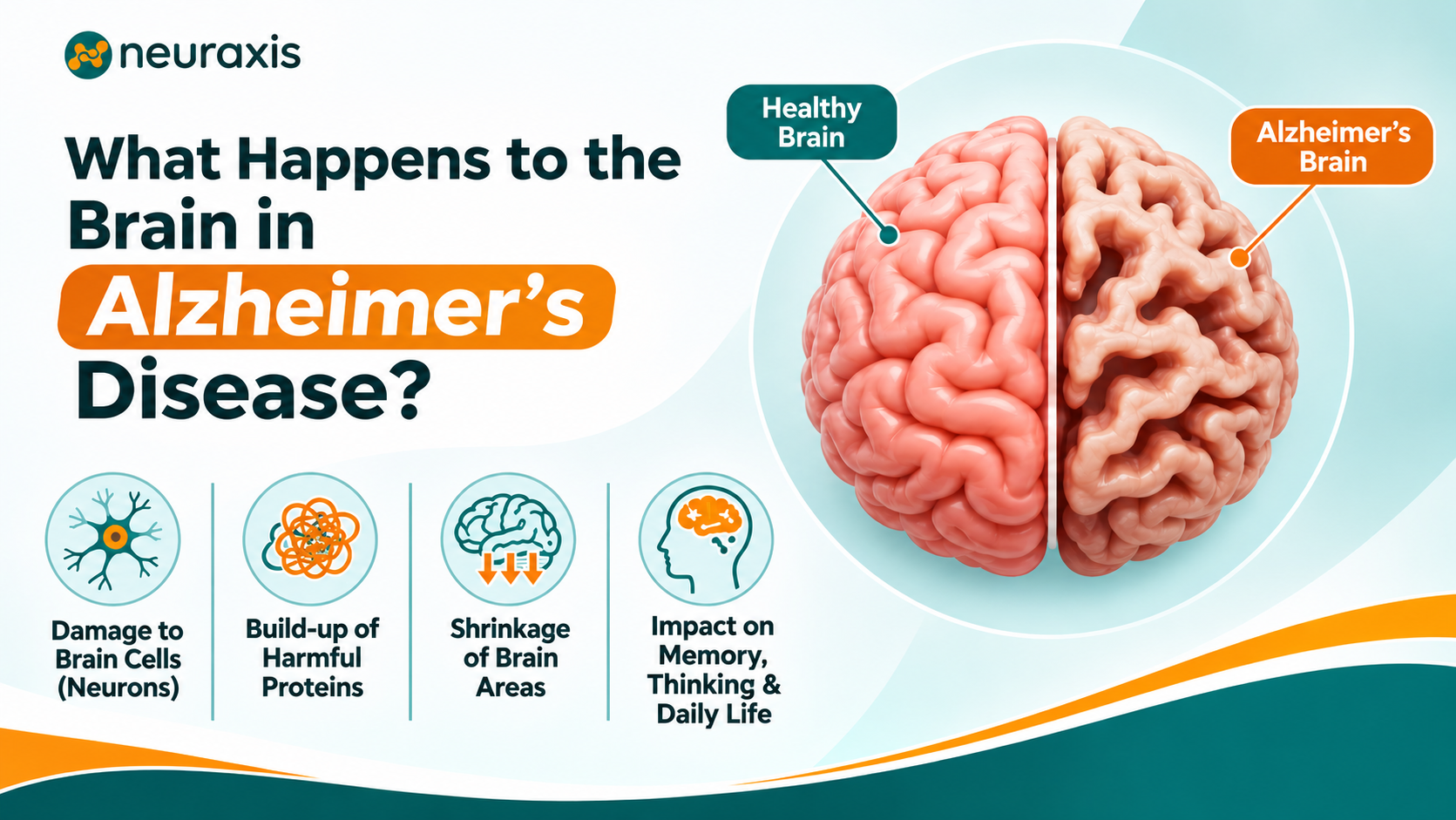
Alzheimer's disease causes toxic protein buildups that damage, disconnect, and destroy brain cells, leading to severe brain shrinkage and a gradual loss of cognitive function.
Key Physical Changes in the Brain
1. Beta-Amyloid Proteins Form Plaques
Beta-amyloid is a protein that occurs in the brain. In Alzheimer's disease, this protein tends to form clusters and accumulate outside the neurons to form amyloid plaques.
These plaques affect the communication between the brain cells, making it difficult for them to communicate with one another.
This causes problems in terms of storing memory, as one might be unable to remember what happened recently.
2. Tau Proteins Form Tangles
Tau is a protein that helps maintain the internal structure of nerve cells. Tau also helps in the transportation of materials within the nerve cells.
In Alzheimer's disease, the tau proteins change their form and develop into structures known as neurofibrillary tangles.
The neurofibrillary tangles affect the transport of materials within the nerve cells. When the nerve cells are not supported, they can get damaged and even die.
3. Brain Cells Lose Their Connections
Brain cells have to be connected to communicate with each other. They play a part in learning, decision-making, remembering things, and understanding languages.
In Alzheimer's, these connections get damaged. Communication between brain cells fails.
That's why people find it difficult to understand what others say, remember what others tell them, and do their daily activities.
4. Inflammation Develops in the Brain
The brain has certain types of defense cells that work to eliminate unnecessary materials from the brain.
In Alzheimer's disease, these defense cells react to the accumulation of such materials. Over time, the reaction may lead to inflammation of the neighboring tissues in the brain.
The inflammation may contribute to the existing damage in the brain.
5. Brain Cells Die and the Brain Shrinks
As the disease advances, more nerve cells and their connections are lost. Some parts of the brain slowly become reduced in size. This is termed brain atrophy or brain shrinkage.
The hippocampus, an important part for memory function, may get affected first. Other brain parts responsible for language, thought, and behavior will then be affected later on.
These brain changes account for the progression of the symptoms of the disease.
What Part of the Brain Does Alzheimer's Affect?
Alzheimer's does not affect every part of the brain at once. It often begins in areas involved in memory and gradually spreads to other regions.
When people ask what part of the brain Alzheimer's affects, the hippocampus is one of the first areas to be affected.
1. Hippocampus – Memory
The hippocampus is responsible for the creation and storage of memories. It enables a person to have recollection of current conversations, events, and knowledge.
This part of the brain is often affected by Alzheimer's disease first. A person might recall past incidents clearly yet forget happenings from earlier in the day.
2. Temporal Lobe – Memory and Language
The function of the temporal lobe includes memory, comprehension of language, and recognition of familiar sounds.
If there is any problem with the temporal lobe, the individual will have problems remembering names, comprehending speech, and finding words to speak.
3. Frontal Lobe – Thinking and Decisions
The frontal lobe assists in planning, judging, solving problems, and controlling behavior.
Impairment of the frontal lobe could cause trouble in handling money, making plans for daily activities, or making decisions. There might also be an alteration in behavior.
4. Parietal Lobe – Understanding Space
The parietal lobe assists an individual in understanding the spatial relationship between objects and movements of the body within space.
Damage to this brain structure results in difficulty judging distances, navigating, and performing normal functions such as dressing up.
5. Occipital Lobe – Processing What the Eyes See
The occipital lobe analyses the information obtained through the eyes.
Any problems here can cause problems with the perception of vision. The individual will not be able to identify or make sense of shapes and objects.
The sequence and severity of these problems vary from one individual to another.
How Does Alzheimer's Work as the Disease Progresses?
Alzheimer's usually develops slowly. The damage inside the brain increases over time, and the symptoms become more noticeable.
The condition is commonly described in three stages.
|
Stage |
Changes Inside the Brain |
Problems a Person May Face |
|
Early stage |
Damage mainly affects memory-related areas. |
Forgetting recent events, repeating questions, and difficulty learning new things. |
|
Middle stage |
Damage spreads to areas involved in language, thinking, and behaviour. |
Difficulty speaking, recognising people, managing money, and completing daily tasks. |
|
Late stage |
Widespread brain cell damage affects several brain functions. |
Difficulty walking, eating, swallowing, communicating, and managing personal care. |
The disease does not progress at the same speed in everyone. Some people experience memory problems first, while others may notice changes in language or behaviour.
What Does an Alzheimer's Brain Scan Show?
An Alzheimer’s brain scan is used by healthcare professionals to detect changes within the brain. It could also help exclude other conditions that might cause memory loss. Doctors can order various brain scans depending on patients' symptoms.
- MRI Scan: This scan provides clear images of the brain. It can detect shrinkage in specific regions of the brain, such as the hippocampus. Other conditions that can cause memory loss can be detected using this scan.
- CT Scan: This scan allows checking the brain shrinkage, brain hemorrhaging, brain stroke, and other changes in structure.
- PET Scan: This scan allows doctors to study brain activity or detect some abnormal proteins associated with Alzheimer's disease.
The Alzheimer's brain scan alone cannot diagnose Alzheimer disease. The information from the brain scan, together with memory test results, medical history, physical examination, and other test results, is taken into account while diagnosing.
Can the Brain Recover From Alzheimer's Disease?
The brain damage caused by Alzheimer's cannot be undone at present. Brain cells that are lost are not able to regrow and make up for the loss of functionality due to Alzheimer's.
But treatment can assist in managing symptoms. Medication can delay the deterioration of some individuals. There is also medication that targets amyloid proteins and can assist in delaying the development of early Alzheimer's.
Exercise, proper sleep, social contact, and familial support can also help someone manage their everyday functioning.
Treatment varies based on individual circumstances. A neurologist can assist you in knowing what treatment will suit your condition.
When Should You Consult a Neurologist?
Memory issues must not be taken lightly once they interfere with daily functions.
One needs to consult a neurologist if they experience any of the following:
- Keep forgetting recent conversations.
- Become disoriented in familiar environments.
- Have difficulty handling finances and medications.
- Cannot comprehend straightforward instructions.
- Face difficulty in retrieving words while speaking.
- Exhibit unexpected changes in mood or behavior.
This is not necessarily a sign of Alzheimer’s disease. Sleep deprivation, depression, vitamin deficiencies, thyroid dysfunction, and certain drugs can impair one’s memory.
The physician will determine what might be the underlying cause and recommend appropriate tests.
Sudden confusion is distinct from the slow change that characterizes Alzheimer’s. It is important to seek urgent medical attention if sudden confusion accompanies weakness on one side of the body, inability to speak, severe headaches, or a drop in level of alertness.
Conclusion
Alzheimer's slowly changes the way the brain works. This affects the brain cells and connections responsible for memory, language, thinking, and behaviour. These changes may begin even before noticeable symptoms appear.
Persistent memory problems, confusion, or changes in cognitive function should be evaluated by a qualified specialist. Dr. Sameer Arora, with more than 10+ years of experience in neurology, can help assess these concerns and recommend appropriate care. If you are looking for the Best Neurologist in Gurgaon, consult Dr. Sameer Arora for proper evaluation and guidance.
Frequently Asked Questions
1. Is it possible to have an ordinary life when suffering from Alzheimer's disease?
It is possible because most individuals continue their routines after being diagnosed. The level of assistance will depend on the level of the progression of the disease. Regular care and support from relatives will make life simpler.
2. Is it possible for Alzheimer's disease to lead to changes in personality?
Yes. It is possible since the damage done by the disease affects the areas that regulate emotions and behavior, leading to anxiety, irritability, suspicion, and withdrawal.
3. Is Alzheimer's disease bilateral?
Yes. It can be bilateral even if the brain areas damaged are not equal and may not occur simultaneously in the two sides of the brain.
4. Why do patients with Alzheimer’s remember old things but not the recent ones?
The sections of the brain responsible for making new memories usually become impaired early on. The older memories might stay easy to recall for a while. That explains why a patient might be able to narrate their childhood in detail yet not remember the morning discussion.
5. Is walking and swallowing impaired by Alzheimer’s disease?
Yes. The damage done to the brain in later stages of the disease can interfere with functions related to movement and swallowing.